

Host
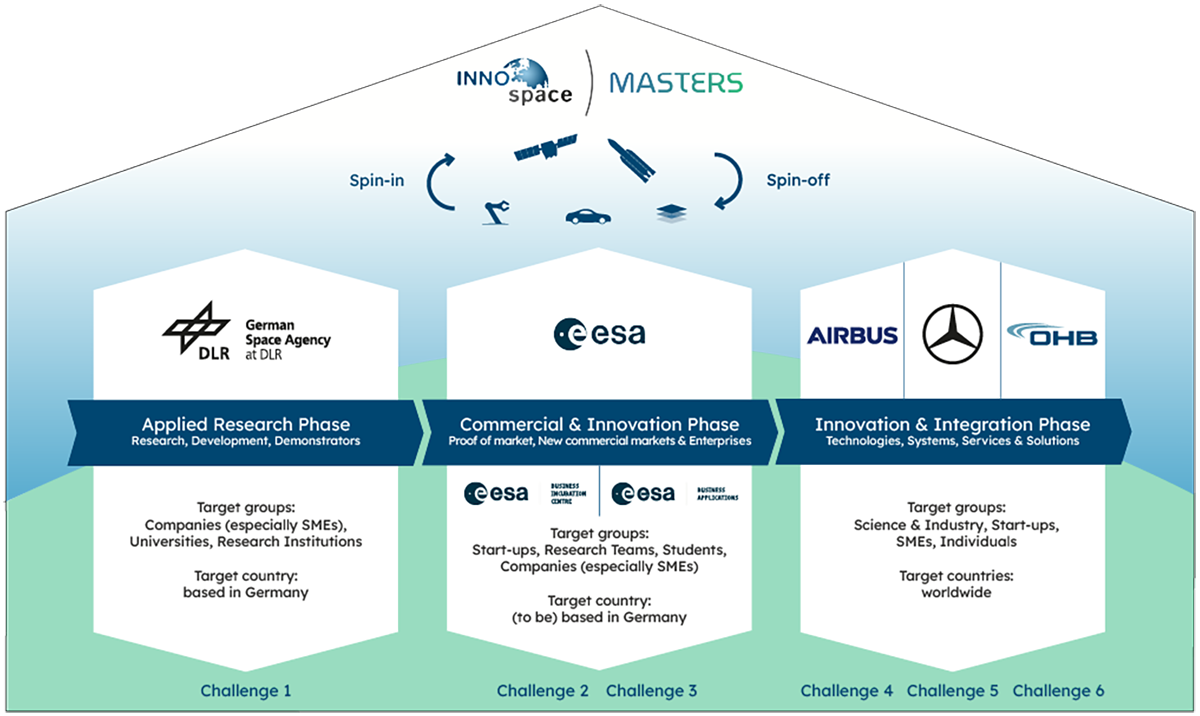
INNOspace Masters promotes ideas for the transfer of technology and expertise from other industries to the space sector (spin-ins/New Space) or from space to non-space sectors (spin-offs).
The overall theme for the 2026 competition round is:
Engage on Earth, Unite in Space – Exploring Next Level Cross-Sector Innovations
Under this overall theme, the competition offers six different challenges for you to participate in. Each challenge covers a wide range of topics and focuses on a different stage of technological maturity – from applied research to market-ready solutions.
In addition to global networking contacts, the winners will receive technological and commercial support, as well as assistance with project implementation.
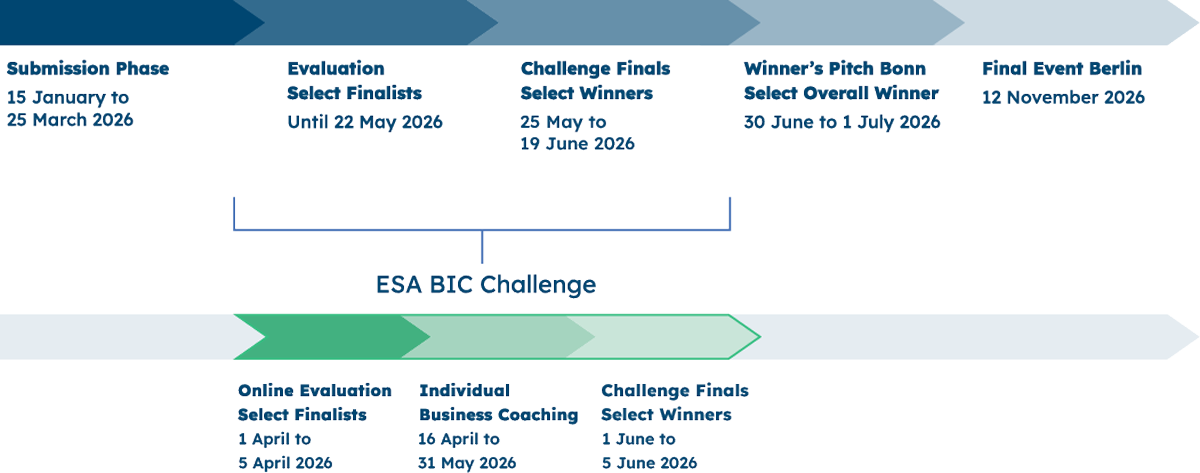
Submission for the 2026 competition round is open from 15 January 2026 (13:00 CET) until 25 March 2026 (13:00 CET).
Here are the most important dates for you if you are taking part in one of our challenges. The ESA BIC Challenge has a slightly different Evaluation Phase, with a shortened initial evaluation and an additional coaching phase.
On behalf of the Federal Government, the German Space Agency at DLR designs and implements the German Space Programme, which integrates all German space activities at national and European level.
The German Space Agency at DLR has started the INNOspace® initiative to promote innovation, technology transfer and new markets.

The challenge:
The space sector continues to evolve: Increasing numbers of new concepts are becoming economically viable, giving rise to emerging markets and creating new opportunities for space industry innovation. At the same time, the space industry is integrating hardware, technologies, and approaches from terrestrial sectors, further accelerating its transition. In this context, the German Space Agency at DLR is seeking for ideas and concepts for space spin-ins and spinoffs that can lead to technologies, processes, and applications with cross-sector relevance.
The DLR Challenge will award four projects in two categories:
The focus of the DLR Challenge is on technology with a pre-commercialisation TRL (Technology Readiness Level). Of particular relevance are collaborative projects from consortia that combine expertise from industry and research.
Team up with relevant partners and submit your idea!
This year, the DLR Challenge is open to various cross-sector innovation ideas. The following topics are provided for inspiration:
The European Space Agency (ESA) is dedicated to the peaceful exploration and use of space for the benefit of mankind. Established in 1975, ESA works with its 23 Member States to push the frontiers of science and technology and to promote economic growth in Europe.
ESA Business Incubation Centres (ESA BICs) are the largest network of incubators supporting space related start-ups in Europe. The objective is to support entrepreneurs with a space-based business idea and help them developing their product while getting their company off the ground. In the process, they create and grow clusters of space-related start-ups across Europe.

The challenge:
The space economy has evolved from a niche commercial sector into a vital backbone of our society and economy. Today, leveraging space assets is not just about opportunity; it is about ensuring technological sovereignty and resilience. Space infrastructure and secure data are essential for protecting critical systems on Earth – including energy grids, communication networks, and global supply chains.
To meet these growing demands, we need next generation upstream and downstream technologies that are robust, secure, and sustainable. The ESA Business Incubation Centres (ESA BICs) provide comprehensive support to ambitious entrepreneurs who want to develop these future-proof solutions and drive value across all sectors.
The ESA BICs in Germany are looking for teams with innovative business ideas that strengthen the space ecosystem or utilize space data for secure and scalable cross-sector applications. The teams will receive support to turn their ideas into a viable company.
Potential innovation areas and use cases are:
What you need to bring to participate: Valid space connection, existing business idea, founding team with complementary skills.
The European Space Agency (ESA) is dedicated to the peaceful exploration and use of space for the benefit of mankind. Established in 1975, ESA works with its 23 Member States to push the frontiers of science and technology and to promote economic growth in Europe.
The ESA Business Applications and Space Solutions (BA) programme provides a comprehensive, structured support system for businesses at all stages of their growth. Eligible are businesses from any sector who intend to use space technologies such as satellite navigation, earth observation or satellite telecommunication to develop new commercial services for Earth. The application areas range from health, education and leisure to agriculture, transportation and energy. The goal is to accelerate innovation and collaboration through sector task forces and partnerships.

The challenge:
There are tremendous commercial opportunities by using satellites and the technologies that underpin the resilience of different systems and data. Space assets and insights derived from space data generate value in nonspace domains such as resilient agrifood and Energy systems or finance and insurance and more. Today, more innovative applications are becoming financially feasible. Thus, new commercial opportunities for all sectors arise, while creating benefits for new communities.
In a drive for a sustainable future, the ESA Business Applications and Space Solutions (BA) supports businesses of all sizes and across all sectors to develop innovative solutions for Earth using space data and technology. We are looking for ideas that can lead into commercially sustainable services or applications supporting such as:
Resilient agrifood systems
Resilient energy systems
Finance and insurance for a resilient society
Airbus is a European leader and pioneer in the space sector with a strong focus on technology and industrial development using new commercial approaches. With the vision of linking Earth and Space through viable cross-industry innovation, Airbus aims to boost the commercialization of space in Europe, considering efficiency and sustainability at the same time. The aim is to foster New Space applications by integrating and connecting different systems and sectors along the entire value chain. This is achieved through intensive co-innovation and co-creation between the space industry and terrestrial partners across a variety of vertical markets.

The challenge:
Airbus is looking for innovators with ideas for exceptional hardware, industrial processes, applications, or business models relevant to space that promise to have a lasting impact on our daily lives. The focus is on smart solutions enabling sustainable and commercially viable innovations on topics such as:
Mercedes-Benz AG is part of the Mercedes-Benz Group AG with a total of around 166,000 employees worldwide and is responsible for the global Business of Mercedes Benz Cars and Mercedes-Benz Vans. The company focuses on the development, production and sales of passenger cars, vans and vehicle-related services. Furthermore, the company aspires to be the leader in the fields of electric mobility and Vehicle software. The product portfolio comprises the Mercedes-Benz brand with Mercedes-AMG, Mercedes-Maybach, and G-Class with their all-Electric models as well as products of the smart brand. The Mercedes me brand offers access to the digital services from Mercedes-Benz. Mercedes-Benz AG is one of the world’s largest manufacturers of luxury passenger cars.

The challenge:
Mercedes-Benz is looking for smart innovation for future mobility enabled by space solutions. Join the Mercedes-Benz car2space Challenge at INNOspace Masters:
With more than 40 years of experience as an independent force in the European space industry, OHB tackles one of the biggest challenges of today: The sustainable and cost-efficient use of resources. Thus, especially synergies and developments for space and Earth should be in focus. The technologies developed by OHB cover the entire cycle of space innovation from building and launching satellites into space via establishing ground stations and IT solutions. We are always open to new creative approaches, including the exploration of new worlds in space and on the ground.

The challenge:
Are you ready to push the boundaries of space technology? We’re looking for fresh ideas on how to design space system architectures and solutions based on end-to-end value chains. Whether through increased onboard computing, seamless connectivity via inter-satellite links or a LEO economy, the future space systems will look very different from those of today.
We are seeking disruptive ideas in the following areas:
Learn which criteria the submission needs to fulfill in order to have the best chances of winning the dedicated challenge.